
What you’ll be able to do
Set up simple systems so your business does not depend on you for everything.
- Escape the technician trap by shifting from operator to architectLessons 1–2
- Turn head-knowledge into SOPs and checklists others can followLessons 3–5
- Audit your business to find where it actually breaks downLesson 6
- Delegate systematically — hand off work without losing qualityLessons 8–9
- Hire for roles, not tasks, and onboard through training systemsLessons 10–11
- Run the business on EOS meeting rhythms, scorecards and IDS issue resolutionLessons 15–18
Certificate of Completion
Get a certificate when you finish, to show what you have learned.
Complete all lessons in the course
Who this is not for
This course may not be right for you if:
- You haven't started yet. The course systematises an existing business; the idea and offer courses here come first.
- You have no intention of ever delegating. The whole second module is letting go.
- You're an employee wanting personal productivity. This is business operations, not task apps.
About this course
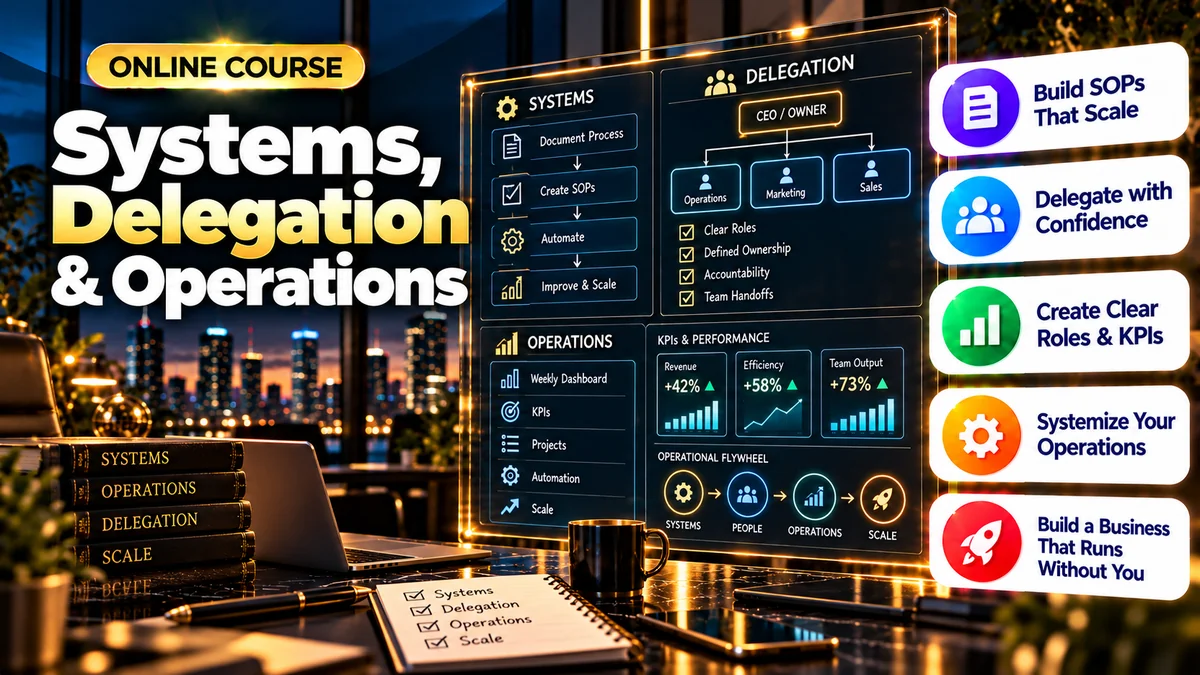
Every process in your business currently runs on one unreliable piece of infrastructure: you. It works — you're good at it — but it means no holiday is truly off, no decision happens without you, and growth just means more of you. The technical term is the technician trap, and technical excellence is how people fall in. This course is the way out, in three modules. Module 1 systematises: working on the business rather than in it, documenting the knowledge in your head into repeatable processes, writing SOPs people actually follow, checklists that prevent expensive mistakes, a system audit to find where the business actually breaks, and what to automate — plus what not to. Module 2 delegates: a systematic hand-off framework, hiring for roles rather than tasks, training systems that replace one-on-one drains, an accountability chart, the Clockwork method, and the art of letting go — ending with a self-managing team. Module 3 operates at scale: EOS foundations, meeting rhythms, scorecard metrics, the IDS issue-resolution method, a business that functions without you, exit readiness, and a closing owner's freedom framework. Twenty-one lessons at five minutes each, with a task per lesson. It suits owner-operators who've built something real and want it to stop depending on their presence — the course assumes a business exists; it doesn't teach starting one.
Frequently asked questions
Quick answers before you start.
How much time does it take?
Twenty-one lessons at five minutes each, plus a task per lesson. The tasks apply to your real business, which is the point.
Do I need employees?
Not to start. Module 1's documentation and audit work on a business of one; Module 2's delegation applies when you're ready.
What are EOS, Clockwork and IDS?
Named operating frameworks the course teaches from scratch — no prior reading needed.
Is this the same as the AI automation course?
No. That one builds tool workflows. This one builds the human and process architecture — SOPs, accountability, meetings — that the tools plug into.
Does "runs without you" mean I should exit?
Not necessarily. The final lessons cover exit readiness as one option; the freedom framework is about choice, not obligation to sell.
Ready to stop doing everything yourself?
Build simple systems and hand off work. You can start with no staff at all.