
What you’ll be able to do
Explore your next step when your career has more than one possible direction.
- Describe a non-linear career as a developing combination of strengths, values, experiences, and experimentsLessons 1–3
- Identify strengths, values, confidence patterns, curiosities, and possible future directions to exploreLessons 2–6
- Use sampling, learning transfer, analogical thinking, and T-shaped skills to interpret varied experienceLessons 8–13
- Design a small, deliberate career experiment before committing to a larger changeLessons 12, 19
- Compare possible next chapters using alternative plans and design-thinking questionsLessons 15–16
- Prepare prototype conversations, networking steps, and a practical response to change or uncertaintyLessons 17–20
Certificate of Completion
Get a certificate when you finish, to show what you have learned.
Complete all lessons in the course
Who this is not for
This course may not be right for you if:
- You want a single guaranteed career path.
- You need regulated employment or legal advice.
- You want a fixed answer without testing options.
About this course
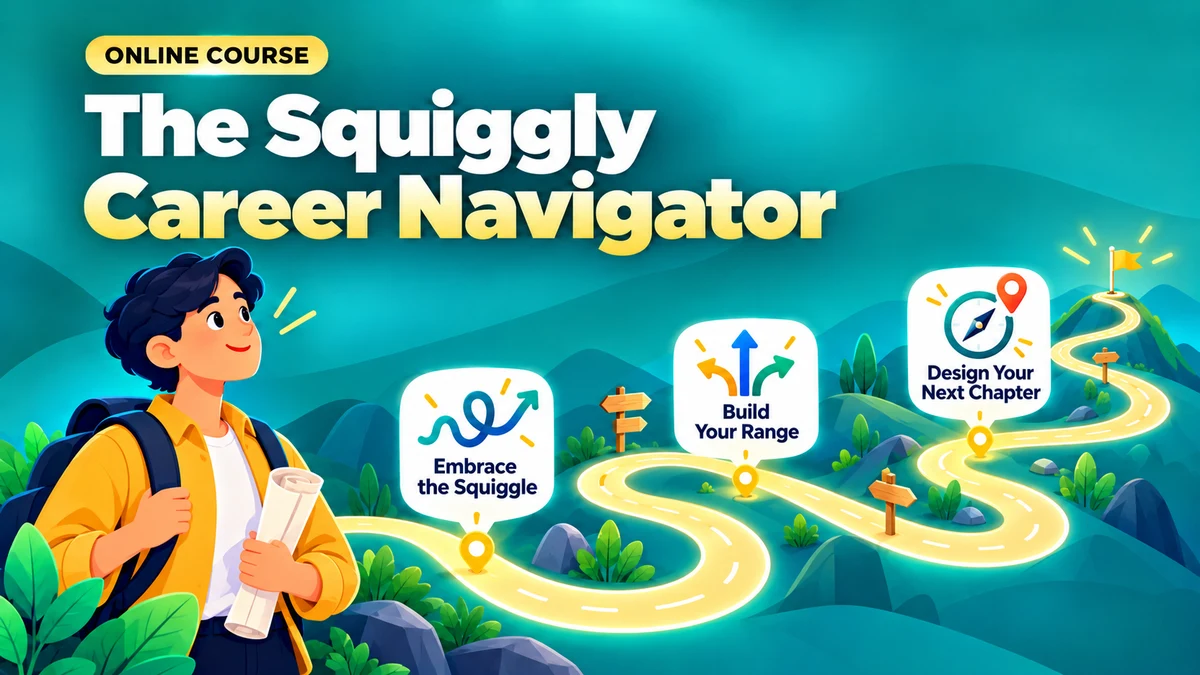
Career decisions do not always arrive as a single obvious promotion or a perfectly linear path. This course offers a practical way to work with changing interests, mixed experience, and more than one possible direction without treating a non-linear career as a problem to solve. The first module explores the idea of a squiggly career through strengths, values, confidence, curiosity, and future possibilities. You will consider what you are learning from your current work and how to describe your experience as an evolving portfolio rather than a fixed label. The second module focuses on range. Lessons cover generalist advantages, sampling periods, analogical thinking, learning transfer, deliberate experimentation, and T-shaped skills. The emphasis is on using different experiences thoughtfully, connecting what you already know, and testing possibilities before making a major commitment. The final module uses design-thinking ideas to shape a next chapter. You will work with alternative plans, prototype conversations, networking, small bets, and resilience through change. Across 21 lessons, the course combines reflection, exercises, quizzes, and practical experiments for anyone who wants to move forward without pretending that the path must be straight.
Frequently asked questions
Quick answers before you start.
Is this course only for people changing careers?
No. It can also support people considering a new role, exploring a different direction, combining interests, or making sense of a varied work history.
What does "squiggly career" mean?
It describes a career that develops through changes, experiments, sideways moves, learning, and connected experiences rather than one straight ladder.
Do I need to know my next move before starting?
No. The course includes exercises for clarifying strengths and values, comparing possibilities, and testing options through small experiments and conversations.
Does the course tell me to leave my current job?
No. It presents ways to explore possibilities and make more informed decisions. Any employment decision depends on your circumstances and should be considered carefully.
Ready to explore your next career move?
Try small experiments and explore your options. You do not need to know your next step yet.
This course is for general educational and career self-development only. It is not legal, employment, financial, psychological, or professional advice. It does not guarantee a new role, career change, or personal outcome. Seek appropriately qualified support for decisions requiring specialist guidance.