
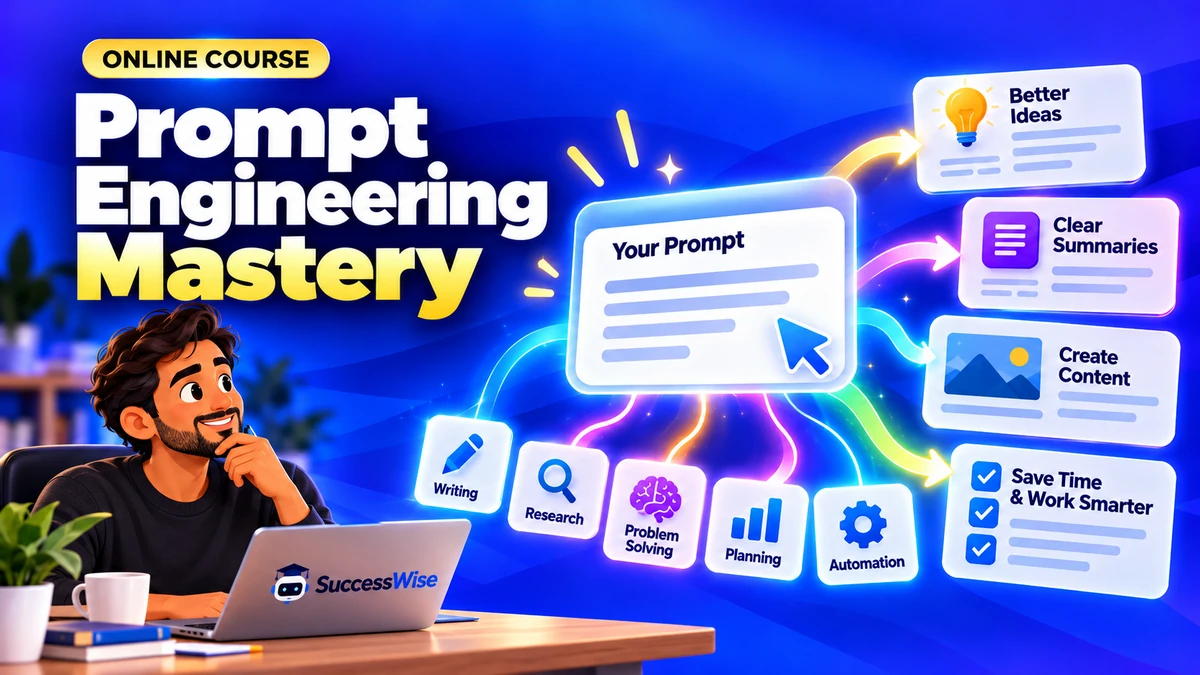
What you’ll be able to do
Learn how to word your requests so AI gives you the answer you actually want.
- Build any prompt from the four-ingredient formula: task, context, format, toneLessons 3–4
- Apply role prompting, chain of thought and few-shot examples by name, and know when each earns its placeLessons 8–10
- Stop accepting weak first drafts — run the iteration loop until the answer is rightLesson 11
- Tell AI what to avoid with negative prompting, and brief complex jobs with context stackingLessons 12–13
- Eliminate the seven common prompt mistakes from your habitsLesson 6
- Finish with a reusable personal prompt library and the advanced "1% moves"Lessons 19–20
Certificate of Completion
Get a certificate when you finish, to show what you have learned.
Complete all lessons in the course
Who this is not for
This course may not be right for you if:
- You've never used an AI tool at all. Lesson 1 covers the basics, but the course moves at practitioner pace.
- You want tool installation walkthroughs. This course is about the words, not the apps.
- You already use chain-of-thought and few-shot prompting daily. Module 2 will be revision.
About this course
You've noticed the pattern. The same vague request goes into the AI, the same mediocre answer comes back, and the fix people reach for is a different tool. But switching tools doesn't change the input. The input is the whole game, and it's a learnable one. This course teaches it properly. Module 1 starts where most people skip: how AI actually reads your words, then the four-ingredient formula — task, context, format, tone — and the seven mistakes that ruin otherwise good prompts. Module 2 is the named technique set: role prompting, chain of thought, few-shot examples, the iteration loop, negative prompting and context stacking. Not as trivia, but as tools you choose deliberately because you know what each one is for. Module 3 points them at real work: writing at scale, research synthesis, ideation, business strategy, then a personal prompt library so your best prompts stop living in scrollback. Twenty-one lessons, five to ten minutes each, with a try-it task in every one and a checkpoint quiz per module. It suits anyone who already uses AI weekly and is tired of accepting the second-best answer.
Frequently asked questions
Quick answers before you start.
How much time does it take?
Twenty-one lessons, five to ten minutes each, plus a short try-it task per lesson. Most people finish in two to three weeks alongside a job.
Do I need a specific AI tool?
No. The techniques work in ChatGPT, Claude and Gemini alike; the course shows examples across them.
Is this the same as the prompting module in the 28-Day AI Challenge?
No. That course teaches one framework as part of a broad tour. This course spends six full lessons on the named techniques and three more on applying them to real work.
Will the techniques go out of date?
The named techniques are stable across current models; the course teaches the reasoning, not button locations.
Ready to get better answers from AI?
Learn how to ask so ChatGPT, Claude and Gemini give you better answers.