
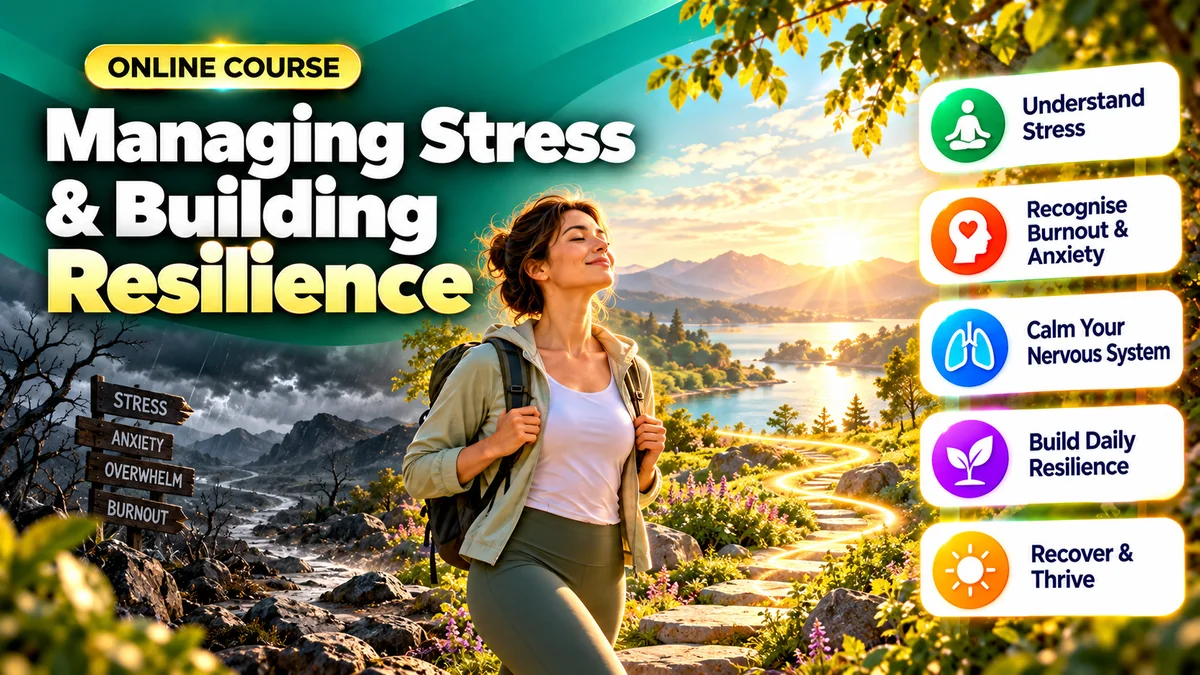
What you’ll be able to do
Understand how pressure affects you and practise simple ways to recover.
- Explain the difference between short-term and prolonged stress responsesLessons 1–3
- Notice personal signals that pressure is buildingLesson 6
- Understand how work, sleep, food and relationships interact with recoveryLessons 8–12
- Practise breathing and present-moment attention as learnable skillsLessons 16–17
- Use cognitive reframing to examine an unhelpful interpretationLesson 18
- Create a personal stress and resilience planLesson 21
Certificate of Completion
Get a certificate when you finish, to show what you have learned.
Complete all lessons in the course
Who this is not for
This course may not be right for you if:
- You want a clinical assessment or treatment plan.
- You expect one technique to remove every source of pressure.
- You are unwilling to examine the routines and boundaries around your work.
About this course
Pressure is part of many working lives, but constant pressure can make it difficult to notice what is happening before the day has already run away with you. A useful course should not ask you to become calm on command. It should help you understand the response, recognise patterns and practise ways to recover. This course is organised in three modules. Module 1 explains what stress is, how the body responds, the difference between short-term and prolonged pressure, and how stress can affect thinking, relationships and daily choices. Module 2 looks at the conditions that make pressure harder to recover from: work demands, rest, sleep, food, connection and the cycle between them. Module 3 is practical. It covers breathing, present-moment attention, cognitive reframing, movement, rest, social connection and a personal plan for building more resilient routines. The course does not ask you to treat yourself or manage every situation alone. One lesson addresses when it is appropriate to seek professional support, and the page disclaimer makes the educational boundary clear. There are twenty-one lessons with practical tasks. It suits people who want a clearer framework for understanding pressure and more deliberate ways to create recovery into ordinary weeks.
Frequently asked questions
Quick answers before you start.
How much time does it take?
Twenty-one lessons with a practical task in each.
Is this a therapy course?
No. It is educational material about stress, recovery and resilience practices.
Do I need to practise meditation?
No. Present-moment attention is one of several approaches covered alongside breathing, movement, rest and connection.
What if the material brings up a serious personal concern?
Stop and speak with a qualified professional. The course is not a substitute for appropriate support.
Is the plan personalised medical advice?
No. The final plan is a self-reflection and routine exercise, not a clinical recommendation.
Ready to handle pressure with more confidence?
Learn simple, practical skills for recovering from a busy working life.
Educational material only. This course is not medical advice, diagnosis, therapy or treatment and does not replace qualified professional support.