
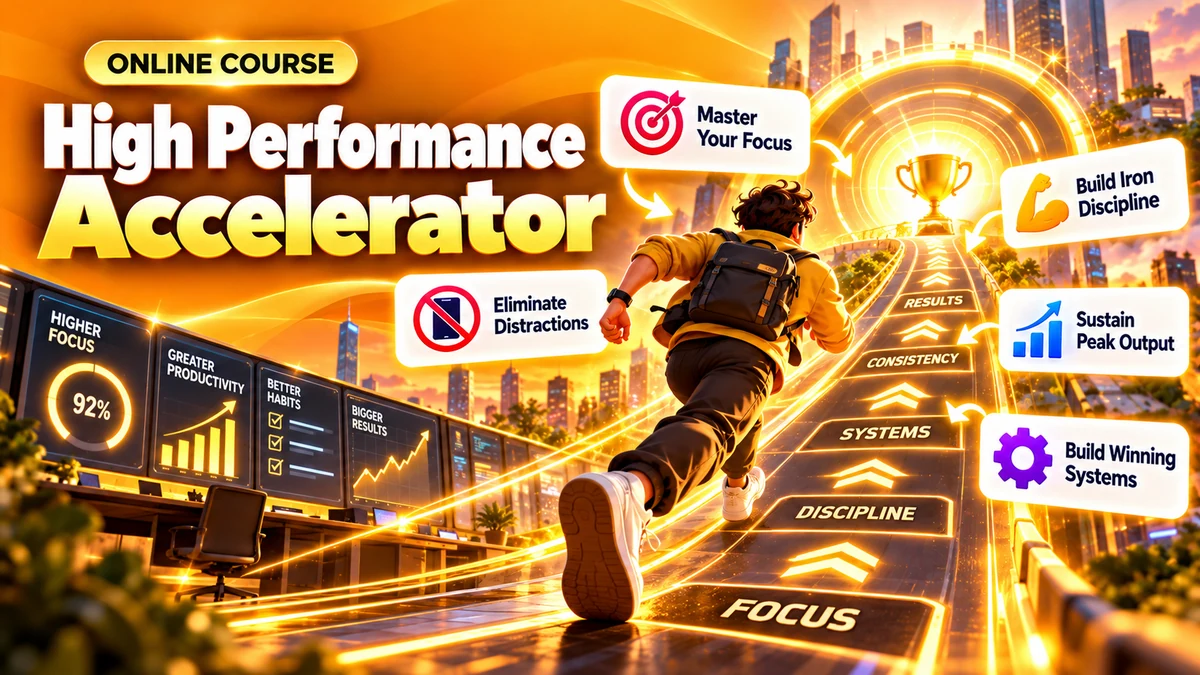
What you’ll be able to do
Build a simple system for focused work, steady habits and proper rest.
- Explain the course's model of attention residue, task switching, deliberate focus, and passive consumptionLessons 1, 3, 4
- Design a lower-distraction work environment using digital, physical, and friction-based cuesLesson 2: "Distraction-Proofing Your Environment"
- Select a deep-work approach that fits your current schedule and working contextLesson 3: "The Deep Work Protocol"
- Build a practical discipline system using non-negotiables, accountability, and temptation bundlingLessons 8–12
- Use recovery, output review, and environment design as part of a sustainable performance cycleLessons 15–19
- Create a personal long-term performance plan that does not depend entirely on motivation or constant intensityLessons 20–21
Certificate of Completion
Get a certificate when you finish, to show what you have learned.
Complete all lessons in the course
Who this is not for
This course may not be right for you if:
- You want a guaranteed productivity formula.
- You need a substitute for workplace or clinical support.
- You want to work at maximum intensity without recovery.
About this course
High performance is treated in this course as a system of choices rather than a permanent state of intensity. The lessons focus on how attention is protected, how environments shape behaviour, how routines reduce unnecessary friction, and how focused work can be balanced with recovery. The first module covers the attention economy, distraction-proofing, deep work, attention training, cognitive load, and focus rituals. You will examine how notifications, task switching, workspace design, and intentional work blocks affect the way you approach demanding tasks. The second module moves from focus to discipline. It explores the limits of relying on willpower alone and introduces practical ideas around identity, non-negotiables, accountability, temptation bundling, and recovering after a lapse in routine. The aim is not to build a rigid schedule that ignores real life. It is to create systems that make the next useful action easier to begin. The final module covers performance cycles, strategic rest, peak-state cues, output tracking, environment design, and long-term consistency. Across 21 lessons, the course combines explanations, quizzes, and practical exercises for people who want a clearer approach to concentrated work and repeatable habits.
Frequently asked questions
Quick answers before you start.
Is this course about working longer hours?
No. It focuses on attention, work design, habits, recovery, and consistency rather than simply adding more hours.
Does it require a specific productivity app?
No. The lessons can be applied with paper, a calendar, a basic task list, or tools you already use.
Is this course suitable for people with changing schedules?
Yes. The course discusses adaptable focus philosophies, environment design, and systems that can be adjusted to different working contexts.
Does the course guarantee higher output?
No. It provides frameworks and exercises for organising focus and habits. Results depend on how the ideas are applied and the learner's circumstances.
Ready to do your best work without burning out?
Focus better, build steady habits and make time to rest. No special app needed.
This course is for general educational self-development only. It is not medical advice, therapy, diagnosis, treatment, or a guarantee of improved work performance. Adapt any routine to your responsibilities, health, employment requirements, and personal circumstances.