
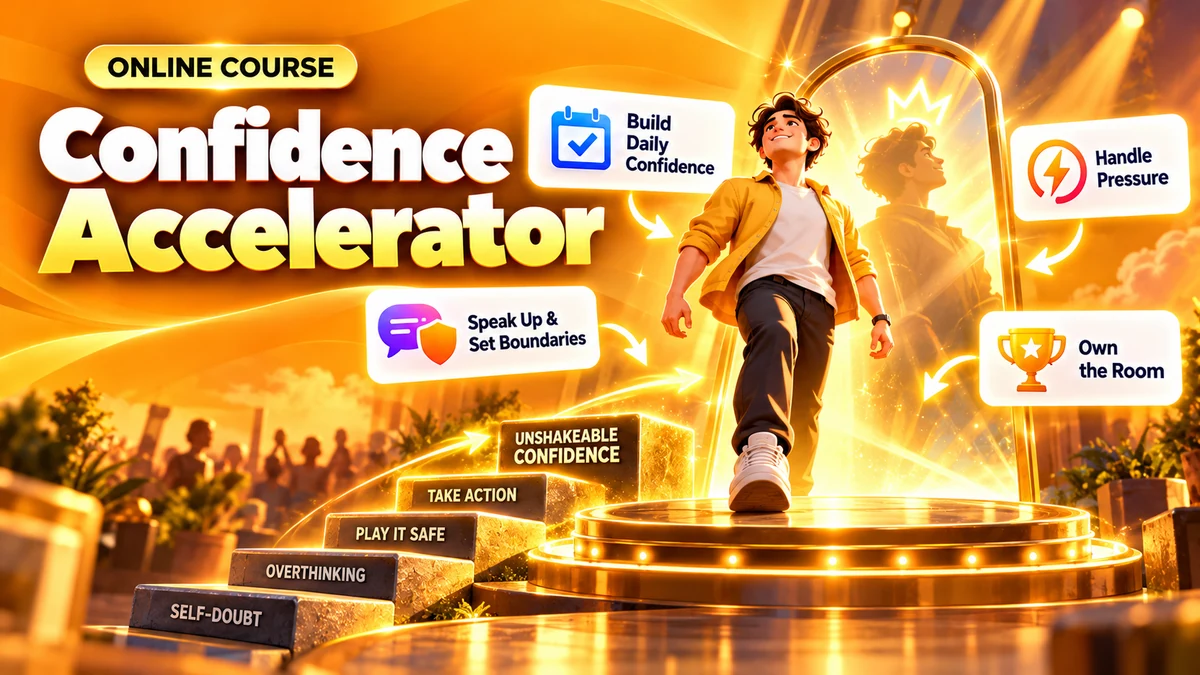
What you’ll be able to do
Treat confidence as something you practise, one small step at a time.
- Explain the course's distinction between confidence, self-efficacy, arrogance, and external validationLessons 1, 3, 15
- Identify the difference between useful self-reflection and unhelpful identity-based self-criticismLesson 2: "Your Inner Critic"
- Choose practical ways to build confidence through small actions, speaking up, and handling rejectionLessons 8–10
- Prepare and practise clearer boundaries in personal and professional situationsLesson 12: "Setting Boundaries"
- Apply course exercises for public speaking, decision-making, and responding to setbacksLessons 17–19
- Create a personal confidence-practice routine based on self-trust rather than waiting for perfect certaintyLessons 20–21
Certificate of Completion
Get a certificate when you finish, to show what you have learned.
Complete all lessons in the course
Who this is not for
This course may not be right for you if:
- You are looking for therapy.
- You need a clinical assessment.
- You want someone else to make personal decisions for you.
About this course
Confidence is not presented here as a permanent personality trait or a feeling you must wait for before beginning. This course treats confidence as a practice: something developed through action, reflection, and evidence gathered over time. You will begin with the foundations of confidence, including self-efficacy, comparison, personal narratives, body language, and the difference between confidence and arrogance. The course then moves into practical situations where confidence needs to be used rather than discussed, including speaking up, handling rejection, setting boundaries, making decisions, and responding when circumstances become difficult. The final module focuses on self-trust, relationships, public speaking, resilience after setbacks, and the identity you build through repeated choices. The emphasis is not on appearing permanently fearless. It is on becoming more willing to take the next useful step, even when certainty has not arrived yet. Across 21 lessons, you will find short explanations, reflection prompts, quizzes, and practical exercises designed to turn abstract ideas into observable practice. The course is educational self-development content, not therapy, diagnosis, or a substitute for professional support.
Frequently asked questions
Quick answers before you start.
Is this course therapy?
No. It is educational self-development content focused on confidence, action, communication, reflection, and practice. It does not diagnose or treat a mental health condition.
Do I need to feel confident before starting?
No. The course is built around practising useful actions before confidence feels complete. You can begin with the exercises that feel most manageable.
Does the course promise that I will never feel fear or doubt?
No. It presents confidence as the ability to keep practising useful behaviour while uncertainty or hesitation may still be present.
Is this course suitable for public speaking or workplace situations?
The course includes lessons on speaking up, public speaking, decisions, boundaries, relationships, and confidence under pressure. It does not replace specialist coaching for a specific professional or personal situation.
Ready to build your confidence step by step?
Start with small actions you can manage. You do not need to feel confident to begin.
This course is for general educational self-development only. It is not therapy, medical advice, psychological assessment, diagnosis, or treatment. If you are experiencing significant distress or need professional support, contact an appropriately qualified professional or relevant local service.